SAMUEL F.C. KIRCHNER
(b.1829 Kochendorf, Germany - d.1904 Ashfield, NSW, Australia
Samuel Friedrich Christian Kirchner was the first son of Georg Andreas Kirchner and Christiane Caroline Margarethe nee Schweizer.
He was born 2 October 1829 at home in the Inn and Bakery "Zum Rössle", High Street, in the little village of Kochendorf, Bad Friedricshall, Württemberg, Germany. His father Georg was a baker and innkeeper.
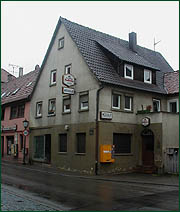
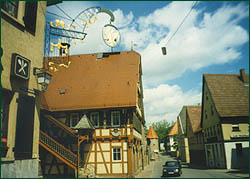
"Zum Rössle", High Street, Kochendorf
(NOTE: Photo taken 2005)
|
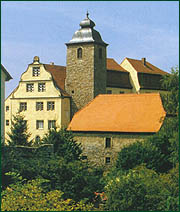
Quaint buildings
Turrets, towers.....
|
Sebastianskirche, the church where he was baptised (and later married) still stands.
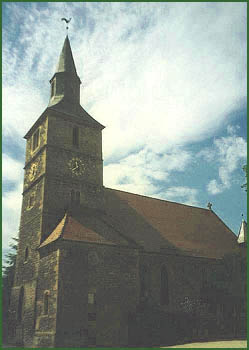
Church in Kochendorf where
SFC Kirchner (Snr)was baptised and married his
first wife Frederica Catharina nee Knapp |
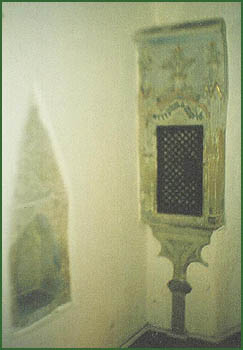
Relic inside Church
(Sebastianskirche)
Kochendorf, Wurttemburg, Germany
|
The present town of Bad Friedricshall arose in 1933 from three villages - Kochendorf, Jagstfeld and Hagenbach. It is possible that the "Zum Rössle" building may have been the town hall of the former village Kochendorf. It was built in 1597.
The name Kochendorf comes from the Kocher River and 'dorf' (village). Neckar and Jagst were other rivers close by.
Dennis and I visited Germany in 1997 and as we left the autobahn and approached Kochendorf, what a thrill it was to finally see the name signposted - all those years of reading about the village which had been here for so long, now we, also, were here!
The river carries enormous barges laden with salt taken from the ancient salt mines, which are still worked today. There are miles of tunnels connecting neighbouring Heilbronn to Kochendorf, the construction of which we were told was a cheaper alternative to building and installing a second lift, for safety reasaons, in the Kochendorf mine.
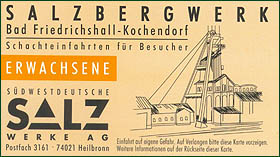
Ticket of entry into the Salt Mine Works, Kochendorf
One part of the enormous mine is now used for chamber concerts, while a large area which is depleted of valuable salt, is set up as a museum. We were intrigued to see a display relating the story of "Saint Barbara", the patron saint of miners! There were piles of salt to rummage through for a souvenir, the ground was in places damp, but mainly the atmosphere was quite enjoyable. We were shown an exhibit depicting many of the art and religious treasures and artifacts that had been stored out of harm's way by Hitler during World War II, and later we saw a beautiful fretwork frieze in a Church in Heilbronn that had been saved from destruction in this way.
We had the honour of taking morning tea with the Mayor of Kochendorf, and he presented us with a book about the village, and a little bag of Kochendorf SALZ (salt). We also met the archivist who had done a lot of the Kirchner research - he showed us through the archives, let me look at some old Kirchner material, and scared the daylights out of me by directing me to a filing cabinet drawer, which, when I peered in, was full of human skulls and bones!!!
We were made so welcome by our newly-met relatives, they spared no effort in showing us all around their beautiful area. We saw so many castles - amongst them the fairytale turrets of Hohenzollern - visited Lichtenstein Castle, Schwetzingen Castle with the asparagus stalls outside the ornate gilded gates, and Heidelberg Castle of "Student Prince" fame. We met their extended family, had a picnic amongst the trees of the forest, sampled Swabian food, even spent a few days monitoring the never changing pattern of the nesting bluebirds and their new babies in their apple tree. In short, they spoiled us and it was a wonderful experience to meet them and share their life for a week.
The relationship between myself and Emme and Helmut lies in the family of Emme. Her 3rd great grandfather Johann Matthes Kirchner was the brother of my 3rd great grandfather Christian Mathaus, therefore we are both descended in exactly the same way from their father - Andreas - our 4th great grandfather!
Samuel Friedrich Christian had eleven known siblings. Friedrich born 1822, Sophia 1824, Johanna 1826, Christian 1828, Carl 1831, Schorsch (George) 1834, Elizabetha 1837, Carolina 1839, Catherina 1840, Wilhelm 1842 and August born in 1844. Brothers Carl and Wilhelm went to live in America. These details are from a researcher in Kochendorf and have not been carried any further.
In the mid 1800's many German people came to Australia and a number of Kochendorf inhabitants were amongst them. A newspaper article documents names, destinations and snippets of information on the various people who left the village.
A translation of part of the newspaper article states "Samuel Kirchner, born in 1829 and his wife Catherina (sic) Knapp found employment in a village near Sydney. He worked as a gardener. Everything he heard about the voyage and the conditions in New South Wales he could attest in his letters. He earned very good, much better than in Kochendorf before. Soon after his arrival his both sons Schorsch and Schani are born in 1857 and 1858".
The town of Kochendorf has quite a collection of memorabilia regarding villagers who left for other countries, and in the Town Hall (Rat Haus) there are originals of the two letters written by Samuel back to his family, dated 1858 and 1859.
Samuel was married just prior to leaving for Australia.
Friederike Knapp
Friederike Catherina was born 4 July 1829 in Kreuzle, Weinsberg, Neckar, Württemberg, Germany to Georg Friedrich Knapp and Catharine Margarethe nee Maier. Her father was a Händler - dealer or trader.
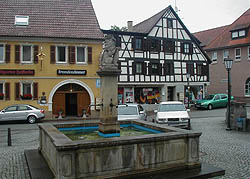
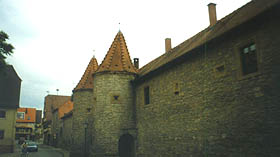
Neckar is the name of the river that flows through the Neckar Valley where the village of Kochendorf is situated. It's a very picturesque spot, with terraced vineyards sloping down to the gleaming water. Many boats ply the waterway including the salt barges, enormous cruise boats and all sorts of pleasure craft. Kochendorf is a maze of winding, narrow streets and old buildings decorated with gold gilded turrets and decorative painted signs.
|
Before leaving the Fatherland, twenty-eight year old Samuel signed a "Severance of Loyalty to the King of Württemburg" document - no turning back!
Samuel and Friederike were married 3 May 1857 in Sebastianskirche, Kochendorf. In a letter Samuel wrote home to his family he mentioned how someone back home had "laughed and mocked his wife about the village" - most probably as Friederike was quite pregnant, their son Schorsch (George) being born on the voyage.
They came to Australia aboard the "GOTTORP" which left from Bremen, Germany and arrived in Sydney 15 September 1857 under Captain Barneldt. She had left Germany 21 May and brought 259 immigrants. The Ship's surgeon was Dr F Jager, Kirchner and Co. were the Ship's Agents in Sydney. This would relate to Wilhelm Kirchner, also from Kochendorf, who became Consul for Prussia in Australia, and was instrumental in starting the 'bounty' scheme to bring German workers to settle in Australia. The "GOTTORP" was a 'full rigged' ship having three masts with square sails.
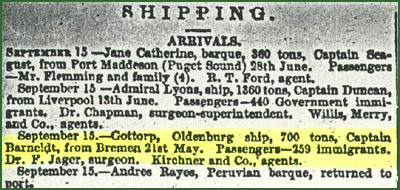
Cutting from Sydney Morning Herald Showing Arrival of “GOTTORP” in 1857
(The ship GOTTORP was named after Gottorf Castle in Germany,which in very early times was known as Gottorp Castle)
Gottorp is unusual for a German name, it seems odd that it ends in "orp". Having only seen the name in Australian documents, maybe it should be Gottorf. Not far from Bremen in Schleswig, is "Gottorf Castle", home of the family who ruled Russia in the 18th century. The castle is now a museum.
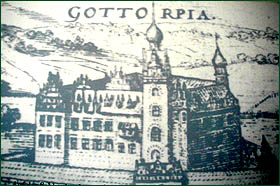
NOTE: We were fortunate in being able to visit this amazing castle/museum in 2005. Whilst enjoying the many wonderful displays we came across a very old framed map which showed the castle as having originally been named Gottorp Castle. Which explains the naming of the ship.....
My great grandfather was naturalised 8 June 1861 and was then living in Ashfield, Sydney. Upon arrival he obtained work as a gardener where he was amazed by the variety and abundance of flowers, fruit and vegetables in the new country. He tells of his wonderful new life and how happy his little family is in letters back home to Germany. A second son Schani (Johann) was born 1858 but died in 1859. John was born in 1860 followed by a sister Maria Chaterina on 30 August 1862. Chaterina is possibly Catherina mis-spelled, this is how it appears on her birth certificate.
Some time before the death of his first wife, Samuel was working as a gardener on a large property at Petersham, a market garden or farm. He built a substantial home at 23 John Street, Ashfield, Sydney. This area was part of the "Taringa" estate, which was divided and sold off in blocks around 1850/60. The home was styled after typical German architecture with a large front gable, and was named "Württemberg Cottage". The large block of land was very good, with fruit trees and fowl house plus a tennis court.
NOTE: "Württemberg Cottage" still stands and has been restored by the new owners, with the help of an architect, to modernise it while still retaining the original Teutonic look.
"Speed the Plough" by Sheena and Robert Coupe, is a book with much detail on the Ashfield area of Sydney. It was released for the city's centenary. The book mentions 'Hermitage Farm' - possibly where Samuel may have been employed as a gardener.
Sadly Friederike's life in the new country came to an end when she died 27 December 1863. She is possibly buried at Camperdown, NSW. A large area of this cemetery has been resumed, and her actual gravesite is unknown.
Her untimely death left Samuel, a working man, with three small children (son Johann had died in 1859) to care for. He engaged a young English woman, Mary Mead, to be his housekeeper.....
To read about Mary Mead, click here
Top

|
